Learning to succeed!
 Children with learning disabilities (LD) can present a variety of challenges for parents and educators. Untreated, these children may also face difficult and unique challenges that are pervasive throughout life. Learning disabilities affect all areas of academia, speech and language. LD can lead to:
- Difficulty following directions
- Trouble learning new information
- Poor memory
- Trouble focusing
- Difficulty with reading and math
- Poor handwriting
Fortunately, although the symptoms may vary, the cause is the same…timing. The domain-general mechanism of timing is a “jack of all trades” mechanism that manifests itself in sleep cycles, speech patterns, ability to attend over time and overall efficacy of brain communication. This timing in the brain, or temporal processing, has been shown to be deficient in several common conditions, including everything from mild learning disability to severe autism spectrum disorder. IM is the only training program that improves timing in the brain in an organized, systematic, flexible and engaging format.
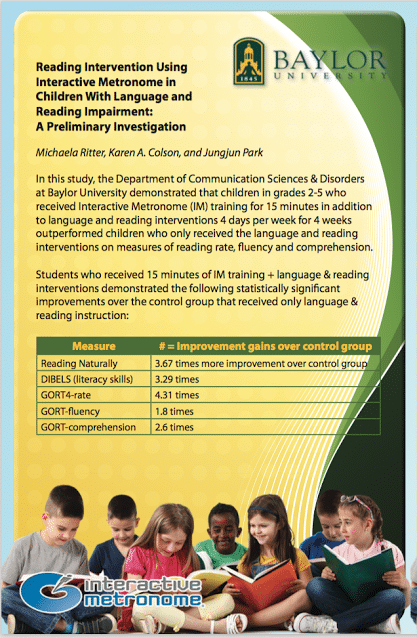
In fact, a study from Baylor University reveals that students who received just
15 minutes of IM training, four days a week in addition to language and reading intervention, demonstrated significant improvement in reading rate, fluency and comprehension over students who just received language and reading instruction.”
Read the Full Study Here
View the Infographic Here
But it isn’t just researchers who are getting wonderful results. Parents love seeing their children blossom before their eyes. Shay’s mother is excited about her skyrocketing self-esteem and improvement in school. Check out her success story below.
Shay is an 11 year-old-girl with ADHD and LD. Her IEP allows her
to go to the school Resource room, have extra time for written
tests, and she is in some special education classes. Shay has
failed many classes but kept getting promoted to the next grade
level. This has GREATLY impacted Shay’s self con dence over
the years as she saw her report cards with consistent failure
marks on them. Her mom wondered if she was truly learning
anything. Shay was very embarrassed and withdrew from
activities with kids from school. She became the child who was
bullied in the cafeteria and on the playground. Other children
would get her into trouble and she would get sent to the principal.
She frequently went to the nurse for stomach issues and also
began receiving some counseling in the community. Shay’s
homework time was a nightmare as was her bedroom which was
a total mess all the time. Her mom would email Shay’s teacher
because her homework notebook was never lled in.
Shay’s mom heard about Interactive Metronome (IM) and sought the program out to help her daughter. IM provides a structured, goal-oriented process that challenges the patient to synchronize whole-body exercises to a precise computer-generated reference beat. The patient attempts to match the rhythmic beat with repetitive motor actions. An auditory-visual guidance system provides immediate feedback measured in milliseconds, and a score is provided. Before Shay started IM she was assessed, and performed terribly, using the Bruininks-Oseretsky Test of Motor Pro ciency and the IM Long Form Assessment (LFA).
Various IM activities were used to help Shay learn how to focus. It was very dif cult for her to attend for longer than a few minutes so we started simple exercises such as bilateral coordination at 100 repetitions and worked her up to 1200 repetitions by our 15th visit.
During our 15th session, we re-administered both the Bruininks and the IM Long Form Assessment and she had significantly improved on both tests.
Shay’s mom heard about Interactive Metronome (IM) and sought the program out to help her daughter. IM provides a structured, goal-oriented process that challenges the patient to synchronize whole-body exercises to a precise computer-generated reference beat. The patient attempts to match the rhythmic beat with repetitive motor actions. An auditory-visual guidance system provides immediate feedback measured in milliseconds, and a score is provided. Before Shay started IM she was assessed, and performed terribly, using the Bruininks-Oseretsky Test of Motor Pro ciency and the IM Long Form Assessment (LFA).
Various IM activities were used to help Shay learn how to focus. It was very dif cult for her to attend for longer than a few minutes so we started simple exercises such as bilateral coordination at 100 repetitions and worked her up to 1200 repetitions by our 15th visit.
During our 15th session, we re-administered both the Bruininks and the IM Long Form Assessment and she had significantly improved on both tests.
On the Bruininks, Shay now scored in the average range in fine motor precision and bilateral
coordination, when she hadn’t even been able to pass before. Her visual motor integration score is now in
the age appropriate range. Her writing has always been neat but now she can print much more quickly and is writing at 81 letters/ minute, (8th grade level). She commented that she now can get her assignments done more quickly in the classroom.
After our last session Shay’s mom told me that Shay had gotten all C’s on her report card that marking period. This was the first time in her life that she had passed any class! She also reported that Shay had gone out for the track team and was sticking with it. She had started to have some sleepovers with some girls from school and was not reporting to the nurse’s of ce for an upset stomach. She was getting her homework done at night and was remembering to turn it in the next day. Her self esteem skyrocketed and her conversations became light and funny. Her mom actually said, “Although this has been the worst school year ever for Shay, she has passed classes for the rst time in her life” with a big smile on her face. IM had a big impact on Shay!
coordination, when she hadn’t even been able to pass before. Her visual motor integration score is now in
the age appropriate range. Her writing has always been neat but now she can print much more quickly and is writing at 81 letters/ minute, (8th grade level). She commented that she now can get her assignments done more quickly in the classroom.
After our last session Shay’s mom told me that Shay had gotten all C’s on her report card that marking period. This was the first time in her life that she had passed any class! She also reported that Shay had gone out for the track team and was sticking with it. She had started to have some sleepovers with some girls from school and was not reporting to the nurse’s of ce for an upset stomach. She was getting her homework done at night and was remembering to turn it in the next day. Her self esteem skyrocketed and her conversations became light and funny. Her mom actually said, “Although this has been the worst school year ever for Shay, she has passed classes for the rst time in her life” with a big smile on her face. IM had a big impact on Shay!
Interactive Metronome is Brain Based Therapy For:
- Academic Improvement
 Alzheimer’s
- Amputee
- APD
- Asperger’s
- Brain Injury
- Career Advancement
- CP
- Developmental Disorders
- Dyslexia
- General Brain Fitness
- LD
- MS
- NLD
- Parkinson's
- PDD
- Stroke
- SPD
- Sports Performance (Improve your Golf swing!)
- Stuttering

321-783-1960
If you or a loved one could benefit from interactive metronome, please call us today!
321-783-1960
Comments
Post a Comment